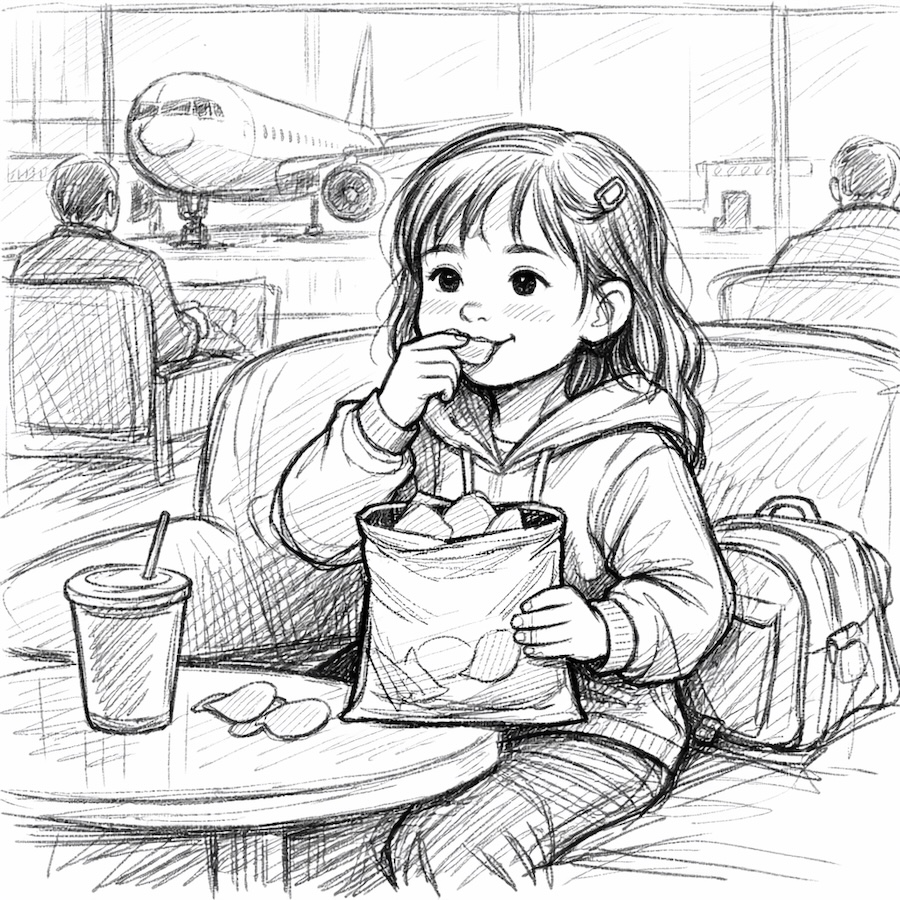
A toddler at Gate 23 awakens the life I almost chose and forces me to reckon with the one I live.
We’re seated by the gate at Logan Airport, held hostage by a delayed flight, watching passengers drift, hustle, and sprint past. Everything feels stale and airless until a little girl, straight out of a storybook, toddles into the seating area. She’s unhurried, unconcerned by the airport’s germs, chaos, and collective striving. She exists in her own pocket of light. My book folds into my lap. I drink her in: clean-faced, bright-eyed—an undeniable gene-pool home run. What would my life have looked like with a child in it?
I don’t often question my decision to opt out of motherhood. My ambition was to become CEO of some wildly successful company, not to wipe little noses. I even left my husband when he wanted kids. But this captivating toddler suddenly feels like proof of a bad call. She looks exactly like the daughter I imagine I might have had—if I hadn’t married that dark-haired, 5’7” husband with a 27-inch waistline, but Robert Redford instead. And of course, I never became that CEO, and most of my jobs have been unsatisfying.
The little girl stands between her mother’s knees, crunching Cape Cod potato chips with inconsistent success, babbling to herself, and occasionally feeding crumbs to “Kit-Tee”, a wide-eyed cat tucked in a crate on the floor. Women all around us watch her with tilted heads—maternal longing, memory, or regret flickering across their faces. I feel it too: the tug of the road not taken. I imagine she still has that warm baby smell, the one akin to puppies.
I elbow Dennis. “If she were mine, I’d give her edamame and fruit. Not junk food.”
In my fantasy, Zoe (yes, she’s Zoe now) eats a virtuous rainbow of organic snacks. My imaginary daughter thrives on virtue.
Dennis glances up from his iPhone, nods, goes back to scrolling.
And then Zoe starts choking. A shard of potato chip lodges in her throat. She goes silent, eyes wide, tears welling. One tiny hand grips her mother’s knee for balance.
The book drops from my lap. I freeze.
Someone—do something.
Zoe’s mother leaps into action, lifting her daughter and laying her across her knees. Three practised pats, and chips of various shapes fly from Zoe’s mouth. Saliva spills over her lips. Air returns. She cries.
The maternal audience exhales. “Is she okay?”
“Yes, thank you,” her mother says, a little breathless.
I retrieve my book from the floor.
Moments later, Zoe is upright again, cheeks wiped, mood restored by some miraculous toddler reset button. She’s perfect again. She asks for another chip. Bystanders chuckle. Her mother offers Goldfish instead of the chips. Goldfish?
Quietly, into my open book, I mutter in a Mickey Mouse voice, “How ‘bout some kale crisps?”
Dennis elbows me: behave.
Our group is called to board. Zoe catches my secret smile, but it means nothing to her.
On the plane, an emaciated woman with an overbite slides into the window seat beside me. As she buckles in, Zoe appears in the aisle screaming like a banshee. Her father carries her stiff and horizontal, surfboard-style, as if this is a familiar transport method. Her mother follows, juggling a bulging tote and Kit-Tee’s crate, wearing an expression equal parts relief (Dad has stepped up) and embarrassment at the din.
Zoe eventually lands four rows behind us. Amid the chaos, she resets again, introducing Kit-Tee to fellow passengers in a sweet, sing-song voice. And again, I feel that pang: mine, mine, mine.
The cabin fills. Phones click off. The air thickens. A teenager licks Burger King remnants from his fingers. Across all of this, Zoe’s voice rises clear as a bell: “No, no, no, Mama!” My romanticized vision of her—those aquamarine eyes, the fantasy of her emerging from my own womb—flickers like an old film reel. I want it to stay intact.
Once we’ve been airborne long enough for the Midwest to appear on the flight map, “No!” becomes a steady chant, punctuated by shushes and parental corrections. My earbuds are buried in the checked luggage, so I have no way to tune her out. I watch the flight display instead, those long rectangular states we’re crawling over at 500 MPH. Dennis types away on his laptop, unbothered, while I listen to Zoe unravel my fantasy, thread by thread.
When we begin our descent, cabin pressure rises, and Zoe unleashes a scream fit for summoning spirits. And finally, my yearning dissolves into something else. Because, if I had had a child, I wouldn’t have driven cross-country or discovered the rugged, aching beauty of the West, doing “boys’ chores”, the ones that injured my leg. I wouldn’t have slept under a sky so wide it made my old life feel claustrophobic. My existence would have been smaller. Quieter. Less dangerous. Less me.
So what, exactly, is the seduction of regret? Even fulfilled, self-aware people fall prey to it. Maybe because longing can be pleasurable. Maybe because imagining our unlived lives makes us heroes in our own minds. We get to be flawless versions of ourselves in the paths we didn’t take. If we’d gone to law school, we’d be courtroom legends. If we’d written the novel, it would’ve been a bestseller. If we’d gone to Hollywood, we’d be movie stars.
And the idea of being a mother is more satisfying when you imagine you would’ve had the perfect child—never mind the choking, the mood swings, the banshee screaming. In the imagined version, she eats kale crisps, never Goldfish, and is always, always grateful.
Zoe pulls me out of my reverie with another burst of outrage. Somewhere around 15,000 feet, the flight display shows the aircraft’s nose briefly aimed at the Pacific before correcting. Passengers glance back toward the sound—even Emaciated Woman—and shrug helplessly. Then we land in big, dramatic drops. Wheels hit the ground. The ordeal ends.
As Zoe and her parents file past us, her father once again carrying her horizontal, I catch her aquamarine eyes. Something inside me loosens. Silently, I thank her for letting me imagine being a perfect mother to a perfect child, and reminding me that perfection only exists in the life we don’t live.
She chirps happily to the woman behind her, introducing Kit-Tee. “He’s pink and purple,” she says.
And just like that, she’s gone, leaving me with nothing but her echo and the quiet, unruly truth that sometimes the child we invent tells us more than the one we never had.

Lisa Mae DeMasi is a writer living in midcoastal Maine where she works at a fishermen’s co-op by day, posting updates on Facebook that tell the story of the working waterfront and fielding community conversations. By night, she revises her novel The Baggage Claim.
Story illustration created by funnypearls.com using natural creativity, artificial intelligence, electricity (generated by windmill on the outskirts of Copenhagen) and hardware from Apple Inc.