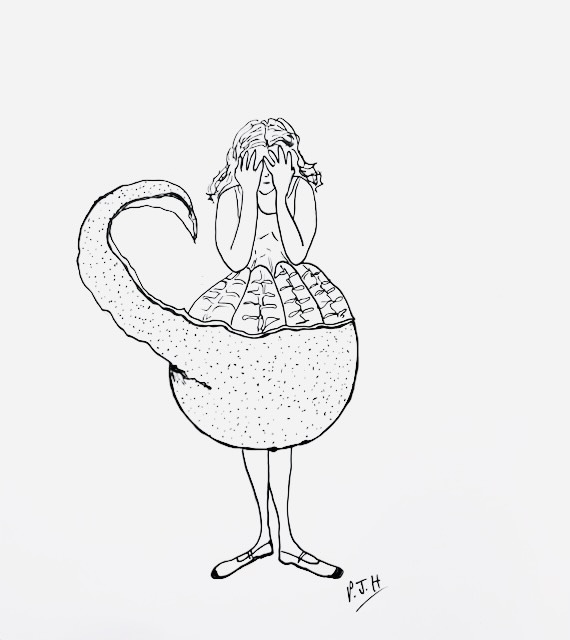
My mother has peeled me an orange. Her eyesight is not good, so there is a thick layer of pith on the segments. I don’t eat food that someone else has touched – there is a taste from their hands – so I leave it in the bowl, as I do every day. We’re having breakfast in the house we’ve inhabited for forty years. She wipes the crumbs from around my plate, and I see the fragility of her wrists, the pink scalp under her thinning hair, the deliberation of her movements, and I feel nothing. I am numb. Soon my role as carer will outweigh my role as daughter and my mind is getting ready, insulating itself against what’s to come. She has kept me with her so that she will not have to negotiate the perilous path of old age alone. I’ve heard her tell people we rub along ok, but we don’t, not really.
I have lived exactly half my life without my father. Since he died, Mum has needed me to carry her grief like she carried my school bag when I was small. It’s a claustrophobic existence. A few years ago I told her I was thinking of leaving, getting a place of my own to be closer to work. She fretted and keened and mourned the loss of me, so I stayed. I don’t even know whether I actually would have done it – rents are so expensive – but I needed to light the touch paper. There was a book I was reading, a difficult book but, in the middle of the words I couldn’t fathom, this sentence jumped off the page: ‘A mother should not breathe into the sails of her child and divert the course of their ship to a different passage’. My mother has taken the helm of my ship.
‘Aren’t you going to eat your orange?’
There is no right answer to this question. All our conversations grow bigger than they should. If I criticise her in any small way she will look crestfallen, a Jane Austen word to match her Jane Austen stoicism. I say, ‘I’ll have it later’, take my plate to the sink and tell her I’m meeting a friend in town. I know she wants to ask which friend, but she swallows the words like a piece of gristle.
‘That sounds nice. You should wear your new coat, it’s lovely on you. Oh, and take an umbrella, it’s going to rain.’
I am in the hall, patting my pockets for keys and phone when she comes out of the kitchen, wiping her hands on her pinny.
‘There was a woman on the bus yesterday,’ she starts. ‘She sat on the outside seat and put her bag down next to her so nobody could sit next to her and there were people standing.’ I fear there will be a long exposition to this story. ‘So selfish. She was talking on her phone the whole time and she had tattoos on her hands.’
‘Some people, eh?’ I put my hand on the door handle.
‘What time will you be back? Lamb chops for dinner.’
I tell her I have no idea and anyway I’ll be eating out, and she shrinks a little.
She reaches up and smooths my hair. ‘You have your father’s curls,’ she says.
Her touch should make me feel something other than irritation. I tell her not to wait up and, as I reach the other side of the pavement, she calls after me, standing in her slippers on the path. She’s wielding an umbrella and looking triumphant.
‘I don’t know what you’d do without me.’ Her reedy voice is faint in the wind. I see her slight body and wish she would be carried off over the rooftops.
I meet Peter at our favourite cafe. We don’t hug but he puts his hands on my shoulders and we inspect each other at arm’s length, checking in. I notice the dark rings around his eyes. We take our drinks round the back where there’s a smoking shelter and a view of the sea. It’s freezing and we blow the steam from the tea into our faces.
‘How have you been?’ he asks. I tell him about something that happened at work and make it funnier than it really was. ‘And your mum?’
I pull my coat tighter around me. ‘I hate being all she’s got.’
His smile straightens his lips but doesn’t reach his eyes. ‘I get it,’ he says.
‘It’s not that I don’t care, but sometimes I pinch myself just to feel something. Is that weird?’
He looks at me and his brows knit with concern. ’You should think about leaving, seriously this time. She’ll be ok without you. She’s not like my dad.’
Peter moved back home a few years ago. His divorce coincided with his father having a stroke, and we joke that at least he had a life before – even if was a disaster.
‘It’s worse for you,’ I say. ‘Do you miss anything?’
He takes a long time to answer. ‘I miss being alone.’
We stare out at the flat, grey sea. I shiver and Peter takes off his scarf and drapes it round my shoulders. The gesture jolts something inside me, and a rush of emotion makes me want to cry.
‘Come on,’ he says. ‘Let’s go down the beach.’
He takes my hand and we walk through the car park, through the scrappy sand dunes, across the shingle to the small patch of sand. The wind whips my hair around my face.
‘Whoever finds the biggest piece of sea glass is the winner,’ I say. ‘Loser buys dinner.’
We part ways and I watch him trudging along, hands pushed down in his pockets. I wander over to the high tide line and scuff the tangle of seaweed, rope and plastic debris, and suddenly right there at my feet is a piece of glass, translucent, azure. I pick it up and feel the cool smoothness of it. I put it in my pocket and say nothing because I want him to be the winner.
‘Any luck?’ I call.
Peter is sitting on a rock, hunched over, lost in thought. He looks up and it’s as if the clouds have lifted.
‘I know what we should do,’ he says. ‘Let our worlds collide.’
My mother has peeled me an orange. I’ve pushed the bowl away, but she is too distracted to notice. She is applying lipstick and is wearing her pink jumper with the pearl collar.
‘We don’t know how lucky we are, do we?’ she says, peering into her compact mirror and turning this way and that to check all angles of her reflection. ‘We have the use of our legs and all our faculties.’
We have been visiting Peter’s father each Saturday for the last few weeks, and this has caused her to start counting her blessings. She says today she’s going to help him eat a piece of the fruit cake she’s made and read him an article from the paper about NHS waiting times. Peter may go out for an hour, or maybe I will, or perhaps we’ll just be alone together. We’ll see how we feel.
‘Are you going to change?’ She looks critically at my oversized sweater.
I’m holding the piece of blue sea glass, turning it over and over like a talisman. I have already changed, just a tiny bit. It will take time to tumble my sharp edges smooth, unravel my jagged nerves, but one day I will fit comfortably in someone’s hand.
 Lesley is a huge fan of good food, vintage chic and old fashioned glamour. Her stories are full of people who aren’t afraid to be a bit different and take the odd risk or two. She has been writing for a long time and thinks that stories, like great meals, should be shared.