Mastery of a second language is more than tossing out a phrase around monolingual friends who don’t understand why you’ve suddenly broken into French in the middle of a conversation about a corrupt politician begun in your native English, much less what you are claiming about said politician. A second language is more than something to fling at a restauranteur and native of Athens, who would understand Greek if you were speaking it. To say you are bilingual is more than an entry on your resume that increases your chance of landing a marketing job at Dolce and Gabbana. A second language is essential in our interdependent world.
A quick scan of the Internet with the search term “benefits of a second language” turns up many reasons to be at least bilingual. For example, Berlitz tells us that along with broader job and social opportunities, we will have an easier time traveling, and we will become more empathetic toward other ways of seeing the world: “We rely on empathy to determine what people mean rather than what they say.” It seems to me we need that empathy right now in the United States, where most of us speak only English and I often have trouble figuring out what people mean when they tell me to “spill the tea” or inform me they “zone out on facts”, or assert “I don’t vote because I am not political”.
I was raised in a monolingual family, but my great-aunt spoke some German – well, one German phrase, which she passed along to me: “To say close the door in German, you say: Mock da deer su,” she said. I looked up the actual phrase on Google Translate, and I found that she wasn’t far off: “mach die Tür hinter dir zu”, which the translation site tells me is “close the door behind you”. There were other phrases, including the German for “slam the door” and “could you possibly manage to close the door?”. My great-aunt’s German lacked attitude.
I have from my youth held an earnest desire to learn a language other than my native English. In high school, I earned credits for Spanish I and II. What I remember is that my name in Spanish I class was Lolita (I don’t know why) so every time the teacher said Lolita, she expected me to say something in Spanish. I used to “olvide’ mi cuaderno” a lot, but that’s all I retained from Spanish I. I remember that we had a blue, hardcover textbook for Spanish II.
Passing Spanish I and II in high school excused me from a requirement to take a language in college. However, because I value foreign language study, I signed up for Latin. Latin, I figured correctly, would help me strengthen my language skills in general. I would also be able to show off my etymological knowledge to my friend who claimed to speak French and Greek. I loved learning about ancient Rome and could imagine the thrill of reading the classic texts in their original lingua: Cicero, Tacitus, Seneca!
Shortly before my course began, I hugged the soon-to-be-comprehensible required Latin tome to my chest, inhaled the new-textbook scent and the promise of learning it contained. After the first class, however, I discovered to my dismay that I brought more enthusiasm than discipline to the tutoring table. I was the only student who had registered for Latin that semester, so I had a private lesson tribus temporibus a septimana. By the secunda septimana, my enthusiasm was mortuus. Yes, I wanted to learn. No, I did not want to memorize declensions.
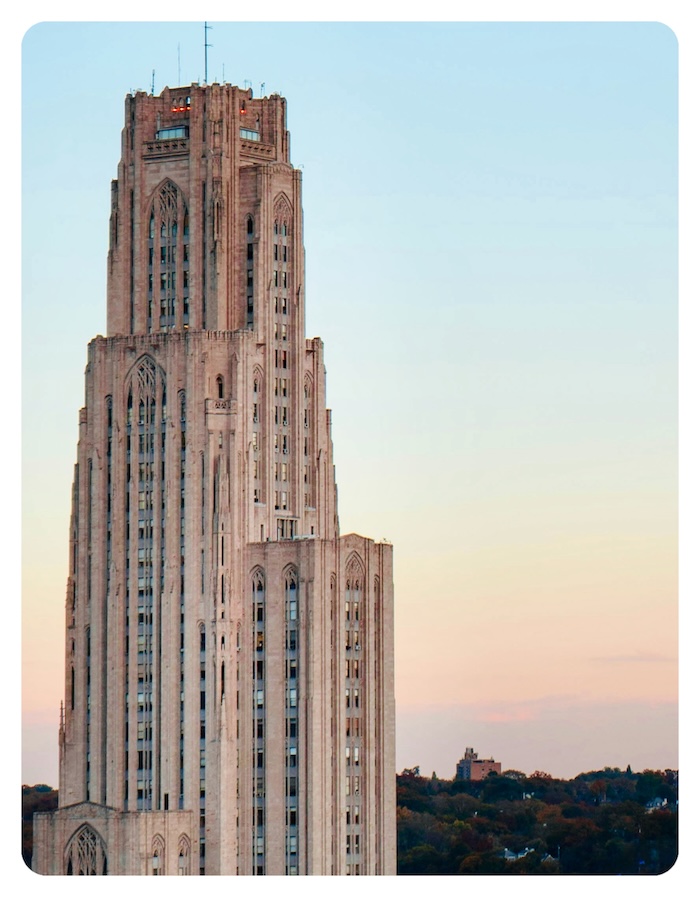
Well, I reasoned, I wasn’t Latin, I was Irish. I would reach into the depths of my own ancient soul, where I was already connected to a language in a primitive, ineffable way. Thus inspired by my Celtic roots – and the study of Cú Chulainn in my Ancient Irish Literature class, I signed up for a non-credit course in Gaelic. This class attracted four other students, and we studied in the Irish classroom, one of the University of Pittsburgh’s Nationality Rooms in its Cathedral of Learning. We five students and our ollamh would gather for study, encouraged by the stained-glass windows, beamed ceiling and dark wood furniture. We would sit upon intricately carved chairs around a long table, breathe in the dusty air of scholarship and emit the words of our ancient ancestors: “Ní thuigim?” What does that mean? I could almost hear the sonorous voices of those from whom I’d descended as they recounted the tales of our people, heroic mythology passed from generation to generation in front of fires in round houses and castles and pubs.
But this was the winter of my eighteenth year, an ideal time to curl up in a chair and read the novels of Jane Austen. My Irish Gaelic book, a small paperback text with phrases about boys and girls and mothers and fathers, was left unattended – as was the fire in my Irish soul to learn Gaelic, which was extinguished as soon as I entered the eighteenth century and spent my evenings in Hertfordshire or Highbury among the Regency English, rather than in the cathedral of learning among the ancient Celts.
Nonetheless, my avid pursuit of a second language continued for the next decades of my life. In college, I attempted Hebrew, German, and American Sign Language. I passed German and ASL. I cannot say anything in German beyond “Mock da deer su”, but I scored a B in the course. I Aced American Sign Language, in which I can sign “tea” and “uncle”.
Outside of an educational setting, I have failed to learn Czech, Italian, and French, all attempts to communicate when traveling. Once, in Prague, a restaurant hostess asked, “How many in your party,” and I explained that I only spoke English. “This is English,” she snapped in unaccented English. Perhaps I didn’t have much of an ear for language.
I asked a waiter in Paris to “s’il vous plait” speak in French because I wanted to learn the language. No typical American, I. He said a lot in French. To me. To himself. To other customers, while nodding his head in my direction. I understood none of the spoken language, but judging from his smirk, I figured he’d enjoyed himself.
From my online research, I have discovered that learning a second language will strengthen my brain and fight off Alzheimer’s and dementia. Learning a second language will help me discern what is important in the world from what is stupid. Learning a second language will expand my intellect, my way of knowing. Journalist and translator Masha Gessen said in an interview with Sean Illing, “Language determines what’s thinkable…. [I]t’s very hard to think a thought that you don’t have a word for — it’s impossible, in fact.”
I feel a need for new words. Words beyond I, me, us, and them. Returning to the first language I studied, I think I’ll begin with lesson 1: Con Mucho Gusto.
Image via Unsplash