I am a craft addict. Entering a store, I’ll see something that catches my eye, and think, “Oh, I can make that.” Even though the item is well-made, reasonably priced, and available to take home immediately, I’ll study it, maybe take a picture or two, then go home and research how-to videos, materials, and the tools I’ll need to make the project myself.
I don’t think about the economics of crafting. I don’t believe anyone does. If we did, the entire industry might collapse. I’ll search for the perfect skein of hand-dyed sock yarn, then spend days knitting a pair of socks. Just the yarn costs over $25. And that’s not including the pattern. Socks! A decent pair of socks costs maybe $10 in a nice boutique.
I love to knit. It’s one of the crafts I’ve done since childhood. Now, I knit primarily when I travel. It fills the void of being stuck in an airplane or train seat for hours. My grandmother taught me English-style knitting, which is often called “throwing”. It requires more movement and, in my hands, is much slower than continental knitting, also known as “picking”. I’ll be on a long trip, happily throwing my yarn and knitting away when a continental knitter notices my technique and becomes so distracted by my apparent inefficiency that I receive an unsolicited knitting lesson. One woman actually took my knitting out of my hands to demonstrate how she thought it should be done. Lady, this isn’t about efficiency, it is a labor of love. It’s mine. Go away.
I enjoy working on small projects when I travel – mostly socks and hats. I have beautiful socks, more pairs than I care to count. They are carefully placed in garment bags in my drawers. They are so lovely that I can’t bring myself to wear them.
Then there are the hats. They’re a great travel project because each requires only one skein of yarn and fits nicely on your lap. I don’t even wear hats, but this has never dissuaded me. My hobby isn’t knitting hats, it’s purchasing beautiful yarn and finding people who need hats.
Knitting requires relatively little equipment. Sewing, on the other hand, can introduce an entirely new level of financial commitment. I have an enormous, wall-length cupboard that I purchased from an office that was closing. It is filled with bolts of fabric. Eek! Fortunately, they’re safely tucked behind closed doors, out of sight of my husband’s wandering eyes.
Then there are the zippers, interfacing, hardware, machine accessories, tools, and finally—my sewing machines: There’s Bertha, the workhorse, a vintage Singer machine that can sew through practically anything, and Donna, the first brand-new machine I ever purchased. She’s a Kenmore with plenty of options. Even though she works perfectly, I find her dull.
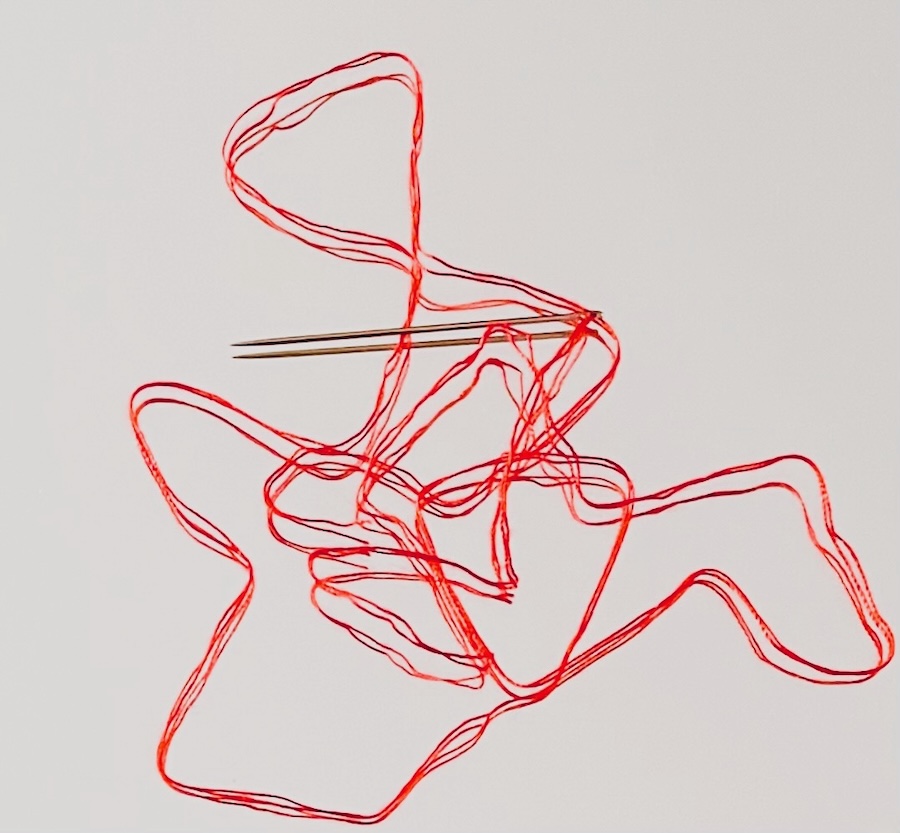
During the COVID shutdown, two more came along. Ella is my favorite. She’s a Baby Lock, not overly expensive or particularly fancy, but she sews beautifully. She’s easy to use, rewards me with perfect stitches, and gets plenty of attention. Finally, there is the one I don’t talk about much: my Million Dollar Baby. She is a Baby Lock embroidery machine and is accompanied by a complete rainbow of embroidery thread arranged on a large spool display across my fabric cupboard. The colorful display is so beautiful that I can’t bring myself to part with it.
Having convinced myself that sewing was a perfectly reasonable use of my time and money, I then progressed to bookbinding. How expensive could it possibly be to turn a stack of paper into a book? As it turns out, that is a question best asked before purchasing the equipment.
The look on my husband’s face when he saw the light-commercial paper cutter coming into the house was something to behold. But his greatest reaction came when I had no choice but to ask him to help me lift my newly acquired antique letterpress. It weighed more than I did. I could see the wheels turning. All this to make a book?
It’s all incredibly expensive. Complete and utter nonsense, really, when you consider that I spend far more money making something than it would cost to buy it. But I can’t stop. Perhaps it’s the pleasure of learning something new, the satisfaction of working with my hands, or that wonderful moment when someone asks, “You made that?”
My husband doesn’t say much, but I’ve learned to recognize the signs: The way he quietly surveys my rather substantial craft storage area. The way he looks at another package on the stairs and asks, “What did you buy now?” And when he sees me beginning another project, he’ll ask, “What are you making this time?”
My husband considers it clutter. To me, it’s potential.

Leslie Boswak is a writer with a lifelong fondness for creative pursuits, beautiful materials, and making things by hand. Her personal essays explore everyday experiences, creativity, and the occasional absurdity of life.
Story illustration by Funny Pearls.