Yesterday the trip had seemed a delightful idea. She had been enthusing to Jacques and his mother about the sunflowers in their wonderful country, that it had been the first thing she had noticed on the train from Paris, how there were thousands of sunflowers, like the daffodils in Wordsworth’s poem – although they hadn’t heard of Wordsworth, not even in translation. Jacques had shrugged in that peculiarly French way, indicating that maybe they were nice, but that he was indifferent to them. Had he noticed, she persisted, that they turned to face the sun? Didn’t that strike him as being remarkably clever? And suddenly Jacques’ mother was suggesting that he take her to see sunflowers in a field nearby. Claire had blushed at what this implied: Madame Vecheur was beginning to like her. His mother hated Jacques taking time off work, and her usual greeting to Claire was simply an eyebrow raised, as you would at a tasteless joke told in church.
Jacques had resisted the idea of the trip, probably out of respect for his mother. His objections were communicated through grunts and gestures that expressed admiration of his mother’s generosity, concern about the chores that he would be neglecting, and a query regarding the suitability of the weather for such an expedition. Claire should have borne this latter point in mind, but at the time, any escape from that farmhouse and that mother seemed welcome.
When Claire had met Jacques on the boat from England – he had been on a business trip involving grain – she had formed a different impression of the sort of farmer he was. She had imagined him – it was embarrassing to think of this now – riding a wild stallion across his lands, and shouting orders at his staff. To be fair, he hadn’t even hinted at this, but his manner was so casual and arrogant that she had assumed he was an aristocrat.
She had been quite clever finding Jacques’ farm some days later, especially as it turned out to be too small to be on any map. Her arrival had surprised her almost as much as it had surprised him and his mother, because it wasn’t the sort of thing she did. But then she had noticed herself acting impulsively recently. It was if the last desperate hormones pumped into her thirty-something body were forcing her to act. She had rationalised this latest whim as a mystical affinity between her and Jacques, but subsequent experience had made her wonder whether the attachment was purely sexual.
But sunflowers! The day began badly with a silly argument about bicycles. The mother, presumably regretting her rash intention to be without her son for a few hours, suggested they cycle to the field. Claire had no objection in principle to cycling, but she thought that in the kind of heat where the sun slammed into you as you walked out of the house, it would be prudent to take a sunshade and walk at a measured pace, stopping frequently to drink. There seemed to be an enormous amount of material in this argument that required discussion, and the mother took to shouting a stream of French and throwing up her hands, and Jacques explained to Claire that the ‘field eez many metres. Many metres to ze field’. Finally, Claire returned to the farmhouse to read whilst they battled it out, until the mother called her to view the bikes which had belonged to some of her other children who had been wise enough to fly the nest at the first opportunity. The ridiculous outcome was that she was at this moment walking sedately under a sensible brolly, whilst Jacques rode several yards ahead on a bike designed for a ten-year-old. His knees came up above the handlebars as he cycled, but he would neither abandon the bike nor join her in laughing at how funny he looked.
It was extraordinarily hot. The road ahead was a shimmer, giving the illusion of water, and there was no-one around. There didn’t seem to be any birds either, though she couldn’t confirm this because the glare of the sun hurt her eyes if she looked up, and her hearing was muffled by the sound of her own heavy breathing.
It occurred to her that marriage to someone whose home was in another country needed to be carefully considered. How would she cope with this kind of heat for many months a year, particularly when she would be expected to help with the various repetitive chores necessary to survive on a smallholding – which was really a more accurate description of Jacques’ place than ‘farm’? She became aware that a certain bothersome noise had ceased – she could no longer hear the squeak of Jacquies’ kiddy-bike. She shaded her eyes and forced herself to brave the glare: there he was, waiting ahead, leaning on a gate. Behind him and stretching on for seeming miles were sunflowers. She judged it appropriate to quicken her pace, to show her delight in the flowers, and she even trotted a few steps, aware that this caused her breasts to move up and down attractively. It was a good decision, for Jacques certainly looked in a better humour when she reached him.
‘It is hot,’ he asserted apologetically, and smiled at her. ‘A long way, yes? You like the hot?’
It was rather alarming, Claire thought, that so much of daily communication consisted of trivial remarks, which, when analysed, were completely pointless. Several times in the last few days she had given utterance to something that had occurred to her, and proceeded to translate it to Jacques. With the aid of a dictionary and mime, she would finally get him to understand that she had seen a tree like that in a friend’s garden, or she had thought there was a picture of a dolphin etched into his bedside table, but it turned out to be a cigarette burn. Of course, when the thought had been rendered clear, they would stand staring at each other for a few moments, and then she would have to pretend interest in some nearby object to relieve the tension. Now she contented herself with an exaggerated mime of beginning to faint, smiling at the same time to show that she was only joking, and hoped that the afterglow of having seen her breasts ‘boonce’, as Jacques had last night described them, would get them over the language gap.
When Claire got close to the first sunflower, she was surprised to see the thickness of its stem. Jacques was watching her reaction, and when she indicated that the stem was too thick for her to encircle with one hand, he held his hand in a similar fashion and smiled lewdly at her, repeating, ‘thick, yes? Big.’ And in fact, the word that occurred to her immediately to describe the flowers was ‘obscene’. It was obvious that the stems would have to be thick to support the heads which looked so bright and delicate from a distance, but were actually the size of dinner plates. The circle of brown from which the petals radiated, revealed itself to be a tight mass of large flat seeds. A breeze that to her had previously been imperceptible, caused the plants to shudder. Their heads met with a clunk, like that of wooden puppet heads touching. The heads were attached to the stems with great bristly saucers – sepals? What did it matter what they were called? Suddenly these plants moving to face the sun appeared sinister. Rather than being joyful sun worshippers, they were grasping for all the environment had to offer. They would have, she was sure, attempted to destroy her if she had come between them and what they wanted. She had an image of them closing in on her with their huge heads wagging. The heat was strobing through her, and with it pulsed a thought about the sunflowers that she didn’t want to think. She was in the most frantic bad temper, insanely irritated by the sweat trickling down her face and her spoiled and frustrating day. Bloody Jacques! His sullen demeanour, his clown-like appearance on the bicycle. And the thought about the sunflowers articulated itself: they were ugly, repulsive.
If only Jacques had not chosen that moment to engage her in conversation. It was obvious that he had rehearsed this speech to avoid any embarrassing misunderstanding.
‘It is difficult for me,’ he began. The expression on his face became more uncertain as he looked at her, undoubtedly seeing a furious irritation in her features as she forced herself to listen to him. ‘You are very nice,’ he said, ‘but it is difficult with my mother and …’. He trailed off. She wondered if he was going to propose marriage, and what she would say. ‘You will go to England soon?’ he continued. ‘Perhaps tomorrow, or next day?’
She had never mentioned a return date, although she would have to be at her post in the library the following Monday. Then it became clear that these were not questions, but requests, and requests that would quickly harden into commands. Of course, she had only been going to stay another five days at the most, and this pathetic trip to the sunflowers had already made her think that five days would be too long. In fact, just before Jacques had spoken, the semi-conscious thought had arisen that she was wasting her time with the sort of mother’s boy who couldn’t distinguish between a woman with education and sensitivity, someone whose gifts were not instantly obvious and needed encouraging, and a simple whore, who would reveal herself from the first and never offer anything more. In fact, in Jacques’ case, the simple whore, especially if she spoke fluent French, would be better suited to him. It would have been pleasing to have been able to say this, or even better, to have said with calm indifference, possibly whilst studying a sunflower head, ‘Oh, yes, I am leaving first thing in the morning. Didn’t I tell you?’
But the combination of heat, the disappointment with the sunflowers, the cumulative frustration of days of having had all speech reduced to the transactional, caused her to burst into tears. There she was, trembling like the sunflowers, her head wagging like some stupid wooden puppet head and tears coursing down her face. The thought occurred that she might blame the tears on an allergy to sunflowers. But she would have to say, ‘Just a minute’, run out of the field, get a dictionary and look up ‘allergy’, and then say, ‘Sorry, what were you saying before I was overcome with my allergic reaction? I hope you weren’t asking me to stay longer than tomorrow, because I must go.’ Unfortunately, though, the choking sobs accompanying the tears could not be explained away so easily.
It was bad enough to cry in front of someone: one never looked one’s best and it also changed your relationship with that person for ever. But worse was the fact that Jacques would think she was crying because he had told her to leave. So now, between sobs, she shouted, ‘No! No!’ and tried to construct the French for: ‘I’m only crying because I’m hot and uncomfortable, the sunflowers are ugly, and everything’s a disappointment. You go somewhere that’s supposed to be beautiful, where you’ll feel like a different person, but when you get there it’s all wrong. Things are beautiful from a distance, but close up, they’re ugly.’
She only got as far as ‘No! No!’ however, and then realised he would assume she was refusing to go. She had a terrifying vision of him and his mother deciding that they would have to kill her to get rid of her – after all, no-one really knew she was there – and burying her at night, probably in that underachieving broad bean patch that seemed to occupy both of their brains so fully. She could see them cutting up her clothes, the mother with relish, Jacques with a regretful shrug. It was imperative to her survival, therefore, that she make it clear to him that she would leave the following day.
Later, on the way back to the farmhouse, Jacques maintained a respectful concern for her, occasionally cupping her elbow in his strong, calloused hand, to guide her around some obstacle. He had the sensitivity to walk next to her, wheeling the kiddy-bike alongside.
She felt the need to explain her bizarre behaviour. It wasn’t a lie, more a metaphor, that would illustrate her emotions in a way that a man, courser-grained that she, could understand. So she told him that when she was a child, she and her parents had lived in a small house with only a square of earth available for growing things. Her father had planted sunflower seeds there, and when they were six feet tall, he had gone out as usual to tend them and suffered a fatal heart-attack.
It did worry her that Jacques might discover that she had never known her father, once he realised that she was the best thing ever to have happened to him and travelled to England to find her. But she was comforted by the thought that then, of course, he would assume that he had simply misunderstood her French.
The story was inspired by an A level English exam question. The author was a teacher at the time, and had to mark quite a few students’ responses. The task was to ‘write a story that includes the following seven items: sunflowers, a horse, a farm….’
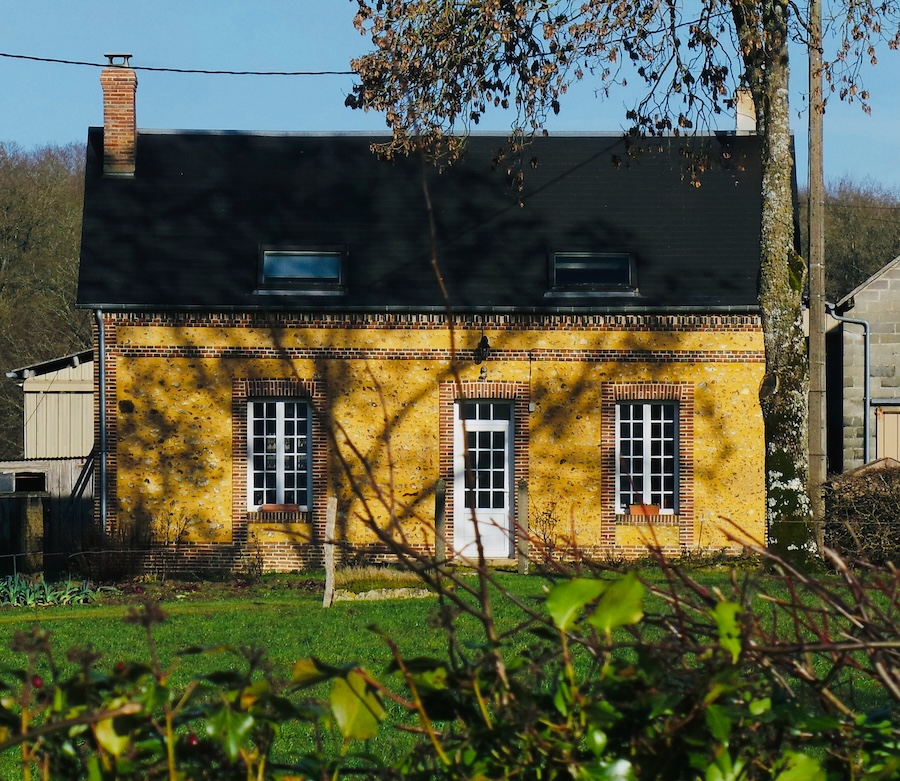
Illustration via Unsplash (edited)